Tag: Group Stage

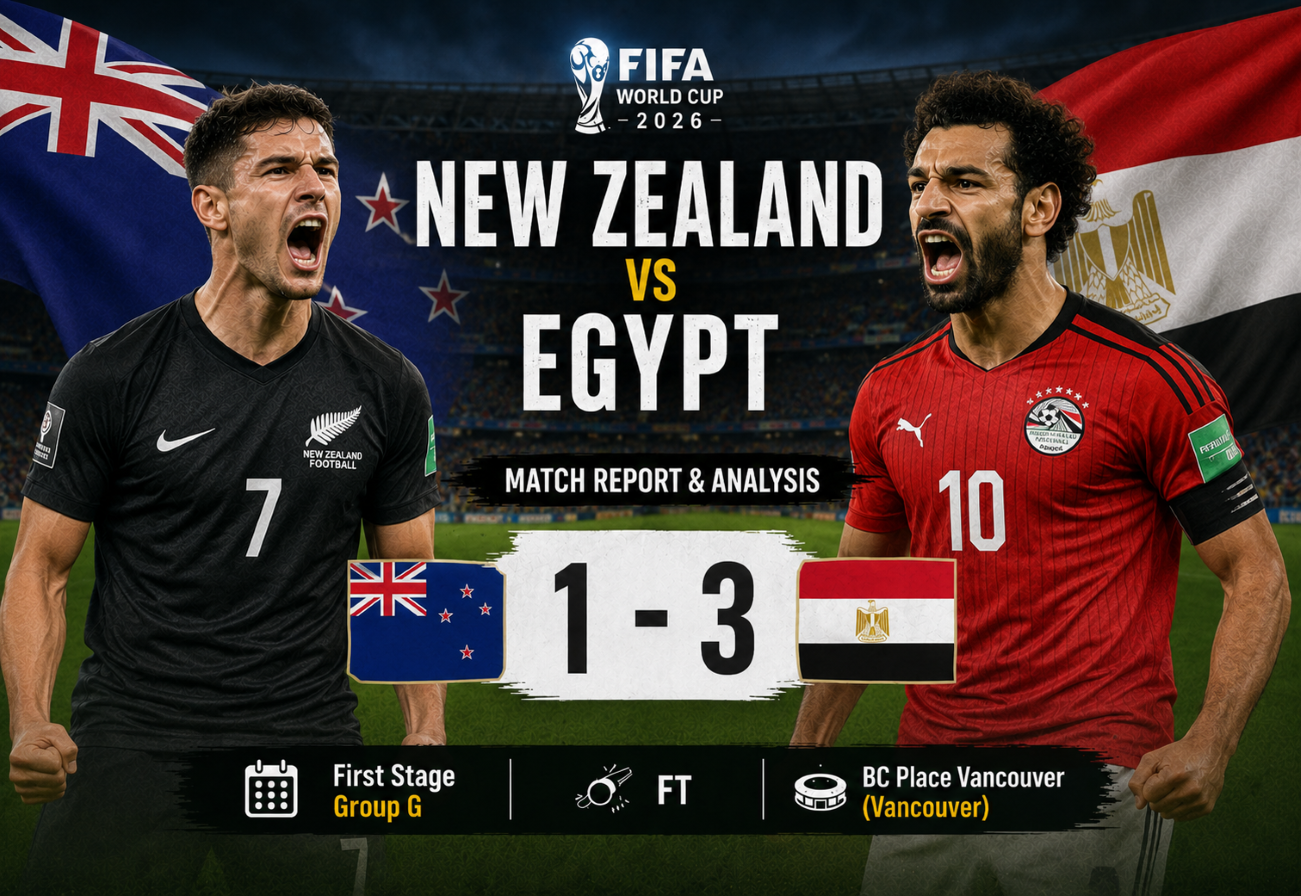
  • New Zealand 1–3 Egypt | FIFA World Cup 2026 Group G Match Report at BC Place Vancouver

    New Zealand 1–3 Egypt | FIFA World Cup 2026 Group G Match Report at BC Place Vancouver

    New Zealand 1–3 Egypt: Pharaohs Dominate Group G Clash in Vancouver

    Egypt delivered a strong and controlled performance to defeat New Zealand 3–1 in their FIFA World Cup 2026 Group G encounter at BC Place Vancouver. The match highlighted Egypt’s superior attacking structure, midfield control, and ability to capitalize on key moments in the game.

    New Zealand showed determination and fought hard throughout the match, but struggled to match Egypt’s intensity and tactical discipline over the full 90 minutes.

    Match Overview

    From the opening minutes, Egypt looked confident in possession, building attacks through structured passing and strong midfield rotations. Their approach focused on controlling tempo and gradually breaking down New Zealand’s defensive shape.

    New Zealand adopted a compact defensive strategy, aiming to stay organized and hit on the counterattack. While their shape held firm in early stages, Egypt’s sustained pressure eventually forced them deeper into their own half.

    First Half Analysis

    The first half saw Egypt dominate possession and territory, circulating the ball patiently while probing for openings in New Zealand’s defensive block. Their midfield controlled the rhythm of the game and ensured continuous attacking phases.

    New Zealand focused on defensive discipline, but found it difficult to maintain long spells of possession. Egypt’s pressing ensured quick ball recoveries and sustained pressure in advanced areas.

    Egypt’s attacking persistence paid off as they took control of the scoreline before halftime, heading into the break with a deserved advantage.

    Second Half Development

    After the restart, Egypt continued to dictate play with confidence, maintaining possession and creating consistent attacking threats. Their movement in the final third stretched New Zealand’s defensive structure.

    New Zealand responded with improved attacking intent and managed to find a goal that briefly brought them back into the contest. However, Egypt quickly regained control and restored their advantage with composed finishing.

    Tactical Breakdown

    Egypt’s tactical approach was built around structured possession, midfield dominance, and quick attacking transitions. Their ability to control tempo and exploit spaces between defensive lines proved decisive.

    New Zealand relied on compact defensive organization and counterattacking opportunities, but struggled to maintain sustained pressure or break Egypt’s midfield control.

    Key Match Statistics

    • Final Score: New Zealand 1–3 Egypt
    • Competition: FIFA World Cup 2026
    • Stage: First Stage – Group G
    • Venue: BC Place Vancouver, Vancouver
    • Total Goals: 4
    • Winning Team: Egypt
    • Match Type: Group stage encounter

    Impact on Group G

    This result strengthens Egypt’s position in Group G and boosts their confidence moving forward in the competition. Their balanced performance across all phases of play underlines their strong qualification prospects.

    For New Zealand, the match highlights the need for greater attacking efficiency and improved control in midfield when facing high-intensity opposition.

    Conclusion

    Egypt secured a convincing 3–1 victory over New Zealand in Vancouver, showcasing tactical discipline, attacking quality, and strong game management. The result marks an important step forward in their FIFA World Cup 2026 Group G campaign.
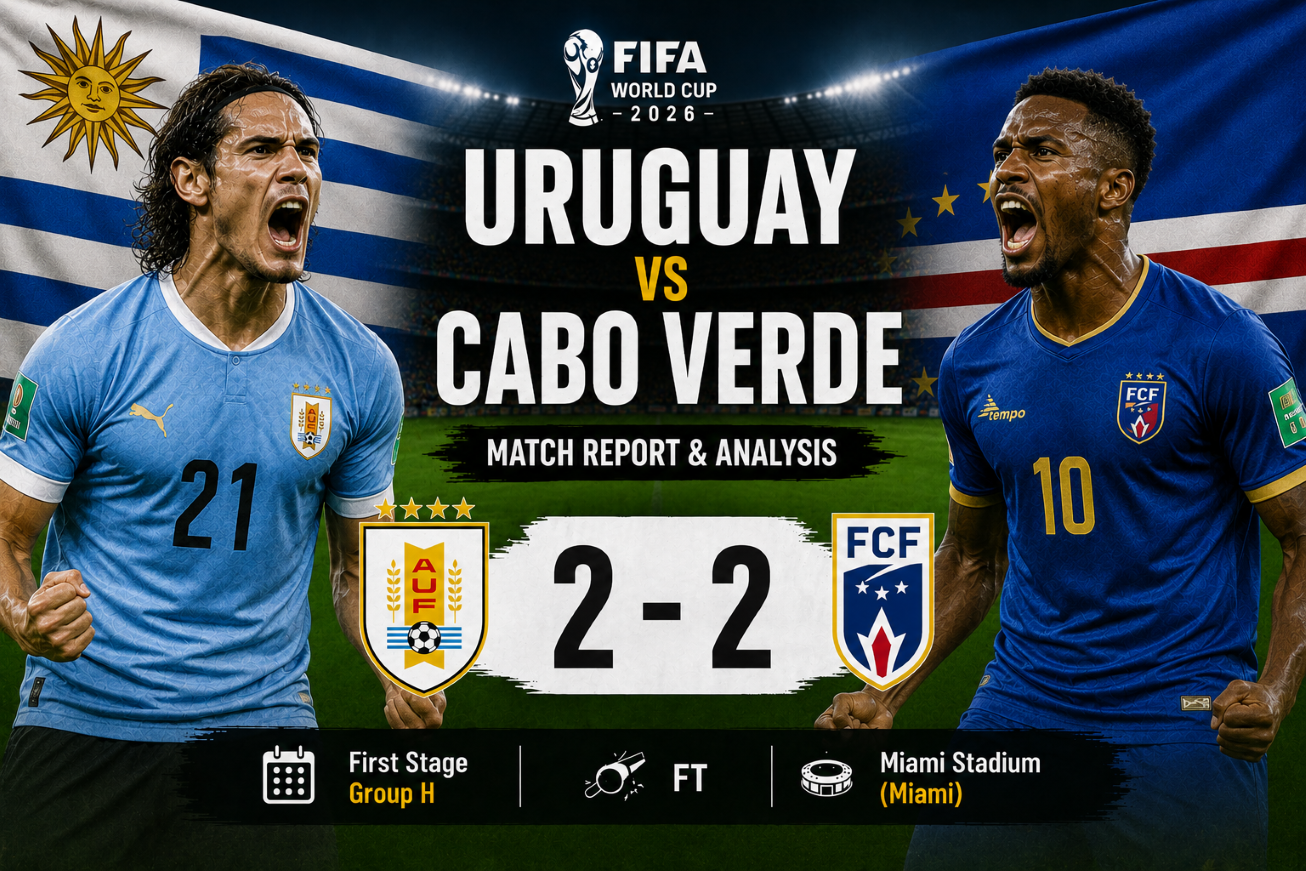
  • Uruguay 2–2 Cabo Verde | FIFA World Cup 2026 Group H Match Report at Miami Stadium

    Uruguay 2–2 Cabo Verde | FIFA World Cup 2026 Group H Match Report at Miami Stadium

    Uruguay 2–2 Cabo Verde: Entertaining Group H Thriller Ends All Square in Miami

    Uruguay and Cabo Verde produced a highly entertaining 2–2 draw in their FIFA World Cup 2026 Group H clash at Miami Stadium. The match was filled with attacking intent, momentum shifts, and competitive intensity from both sides, resulting in a fair but frustrating point shared at the final whistle.

    While Uruguay will feel they had opportunities to secure all three points, Cabo Verde showed impressive resilience and attacking sharpness to remain firmly in the contest throughout the 90 minutes.

    Match Overview

    From the beginning, Uruguay looked to impose their traditional style of structured possession combined with quick vertical attacks. Their midfield aimed to control tempo and create openings through progressive passing into advanced areas.

    Cabo Verde responded with energetic pressing and fast transitions, looking to exploit spaces left behind Uruguay’s advancing full-backs. This tactical contrast created an open and dynamic match from early stages.

    First Half Action

    The first half delivered an evenly balanced contest with both teams finding attacking rhythm at different stages. Uruguay enjoyed longer spells of possession, using patient buildup play to probe Cabo Verde’s defensive structure.

    Cabo Verde, however, remained dangerous on the counterattack, using direct passing and pace in transition to create problems for Uruguay’s defensive line. Their ability to respond quickly ensured the match remained finely balanced.

    As the half progressed, both sides managed to convert their attacking phases into goals, resulting in a competitive and open first-half scoreline that reflected the intensity on the pitch.

    Second Half Momentum Shifts

    After the break, the match continued at a high tempo with both teams pushing for control. Uruguay attempted to increase their dominance in midfield and create sustained pressure in the final third.

    Cabo Verde remained disciplined defensively while continuing to pose a threat on quick breaks. Their direct approach ensured Uruguay could not fully commit forward without caution.

    Both sides added another goal in the second half, keeping the match level and setting up a tense final phase where either team could have claimed victory.

    Tactical Breakdown

    Uruguay focused on structured buildup play, midfield control, and attacking width to stretch Cabo Verde’s defensive shape. Their strategy created consistent forward movement but also left space in defensive transitions.

    Cabo Verde relied on compact defensive organization combined with fast counterattacks. Their ability to transition quickly from defense to attack was a key factor in remaining competitive throughout the match.

    Key Match Statistics

    • Final Score: Uruguay 2–2 Cabo Verde
    • Competition: FIFA World Cup 2026
    • Stage: First Stage – Group H
    • Venue: Miami Stadium, Miami
    • Total Goals: 4
    • Result: Draw
    • Match Type: High-tempo attacking contest

    Impact on Group H

    This draw keeps Group H highly competitive, with both Uruguay and Cabo Verde taking a valuable point but missing the chance to gain an early advantage in the group standings.

    Uruguay will look to improve defensive balance and game management in future matches, while Cabo Verde will take confidence from their ability to compete strongly against a traditionally stronger opponent.

    Conclusion

    Uruguay and Cabo Verde delivered an exciting 2–2 draw in Miami, showcasing attacking football, tactical contrast, and competitive spirit. While neither side secured victory, both teams demonstrated qualities that will make Group H a tightly contested battle moving forward in the FIFA World Cup 2026.

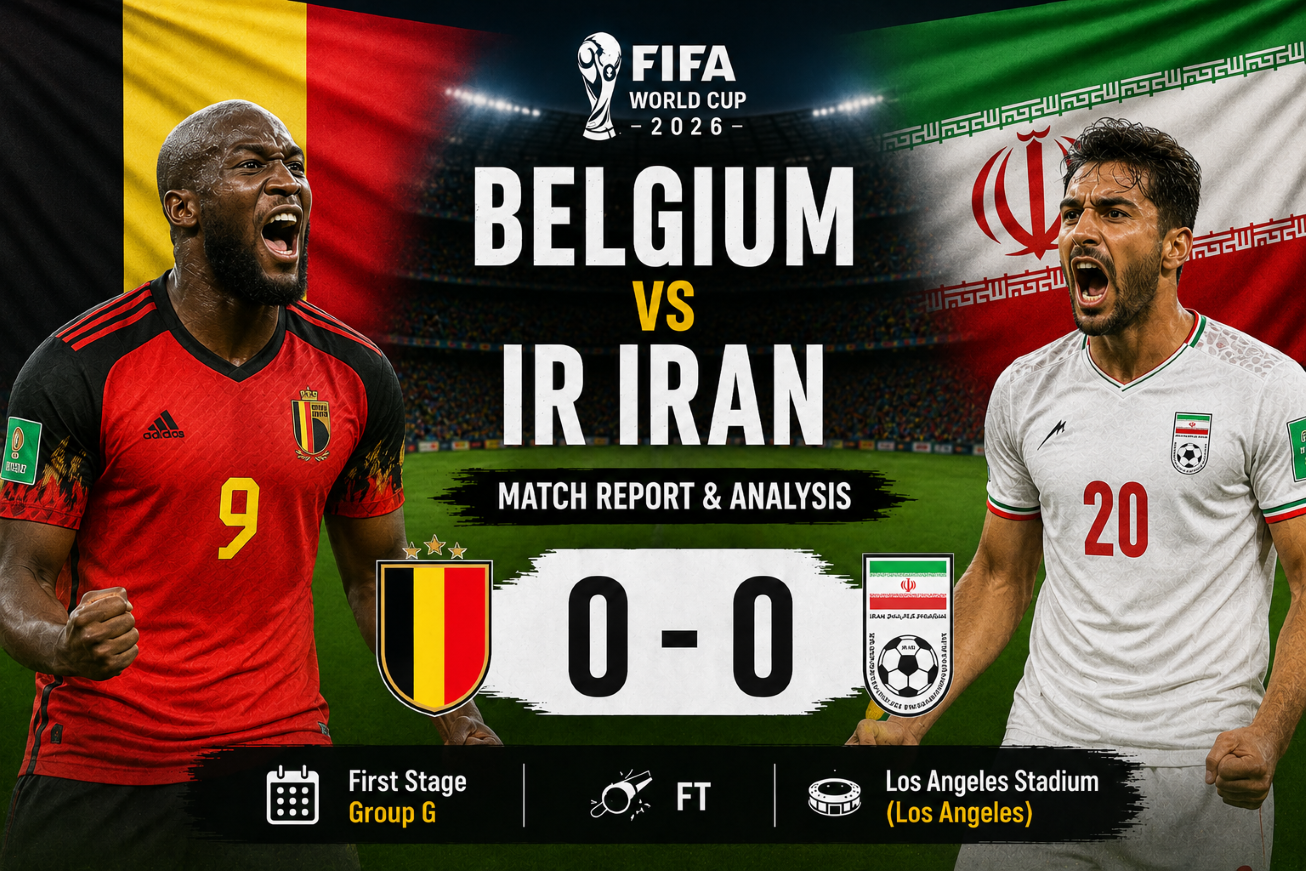
  • Belgium 0–0 Iran | FIFA World Cup 2026 Group G Match Report at Los Angeles Stadium

    Belgium 0–0 Iran | FIFA World Cup 2026 Group G Match Report at Los Angeles Stadium

    Belgium 0–0 IR Iran: Tactical Stalemate in Los Angeles Group G Encounter

    Belgium and Iran played out a goalless draw in their FIFA World Cup 2026 Group G clash at Los Angeles Stadium. Despite both teams showing tactical discipline and structured gameplay, neither side was able to find the breakthrough in a match defined by defensive organization and midfield control.

    The result reflects a tightly contested encounter where Belgium dominated possession for long periods, while Iran’s compact defensive shape and disciplined approach successfully neutralized attacking threats.

    Match Overview

    From the opening minutes, Belgium attempted to impose their passing style and control the tempo of the game. Their midfield looked to circulate possession and create openings through patient buildup and positional rotations.

    Iran, however, executed a well-organized defensive plan, staying compact between the lines and limiting space in central areas. Their disciplined structure forced Belgium to play wide and reduced the number of clear-cut chances inside the box.

    First Half Analysis

    The first half saw Belgium enjoy the majority of possession, pushing Iran deep into their defensive third. Despite this territorial dominance, Belgium struggled to break through Iran’s disciplined defensive block.

    Iran focused on maintaining shape and absorbing pressure, occasionally looking for counterattacking opportunities. However, Belgium’s defensive transition remained solid, preventing dangerous breaks.

    As the half progressed, the match became increasingly tactical, with both sides cancelling each other out in midfield battles and structured defensive setups.

    Second Half Intensity

    After the break, Belgium increased attacking intensity, pushing higher up the pitch and attempting quicker combinations in the final third. Substitutions added energy, but Iran’s defensive resilience remained firm.

    Iran continued to rely on compact defending and quick transitions, but Belgium’s defensive awareness prevented any serious counterattacking threats from developing.

    Late pressure from Belgium included sustained attacking phases, but Iran held their structure and cleared danger consistently, ensuring the match ended in a stalemate.

    Tactical Breakdown

    Belgium focused on possession-based buildup, attempting to unlock Iran’s defense through midfield creativity and wide overloads. However, a lack of space in the final third limited their finishing opportunities.

    Iran executed a compact low-block system, prioritizing defensive discipline and minimizing risk. Their structure effectively disrupted Belgium’s rhythm and forced low-percentage attacking options.

    Key Match Statistics

    • Final Score: Belgium 0–0 IR Iran
    • Competition: FIFA World Cup 2026
    • Stage: First Stage – Group G
    • Venue: Los Angeles Stadium, Los Angeles
    • Total Goals: 0
    • Result: Draw
    • Clean Sheets: Both teams

    Impact on Group G

    This draw keeps Group G tightly balanced, with both Belgium and Iran earning a point each. While Belgium may feel they had more control over the match, Iran will consider this a strong defensive result against a high-quality opponent.

    As the group stage continues, Belgium will look to improve their attacking efficiency and conversion in the final third, while Iran will aim to maintain defensive solidity while becoming more effective in transitions.

    Conclusion

    Belgium and Iran shared the points after a tactical 0–0 draw in Los Angeles. The match was defined by structured defending, midfield battles, and disciplined game management from both sides in a tightly contested Group G fixture of the FIFA World Cup 2026.

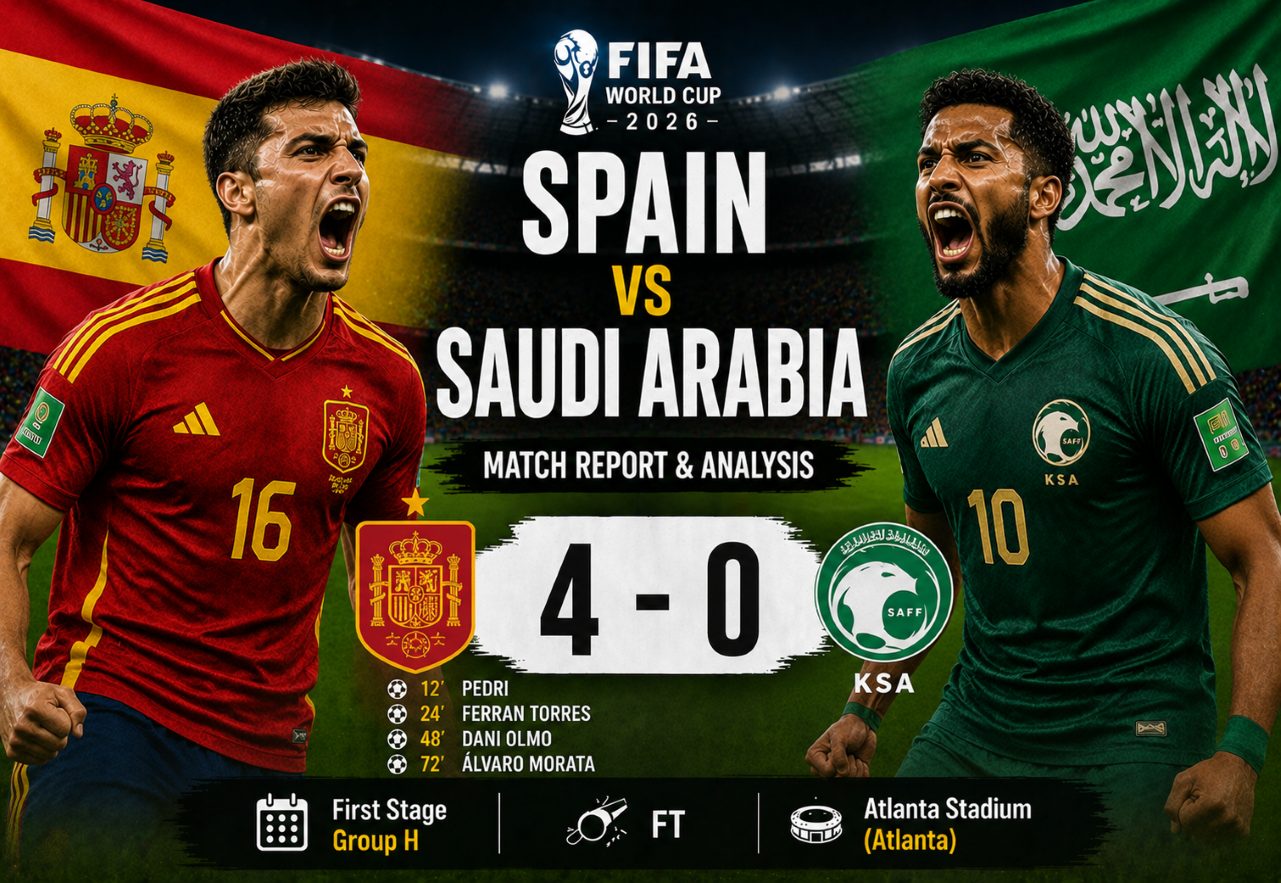
  • Spain 4–0 Saudi Arabia | FIFA World Cup 2026 Group H Match Report at Atlanta Stadium

    Spain 4–0 Saudi Arabia | FIFA World Cup 2026 Group H Match Report at Atlanta Stadium

    Spain 4–0 Saudi Arabia: La Roja Deliver Dominant Group H Performance in Atlanta

    Spain produced a commanding 4–0 victory over Saudi Arabia in their FIFA World Cup 2026 Group H fixture at Atlanta Stadium. The performance reflected Spain’s technical superiority, tactical control, and relentless attacking pressure from the opening whistle to the final minutes.

    Saudi Arabia struggled to cope with Spain’s high-tempo passing and positional fluidity, spending most of the match defending deep under sustained pressure.

    Match Overview

    From the start, Spain asserted control through possession-based football, circulating the ball quickly and stretching Saudi Arabia’s defensive structure. Their midfield dictated the rhythm of the game, allowing them to dominate territory and create repeated attacking sequences.

    Saudi Arabia attempted to remain compact and disciplined, focusing on defensive organization and counterattacking opportunities. However, Spain’s movement off the ball and rapid passing combinations limited their ability to build any sustained pressure.

    First Half Action

    The first half saw Spain control possession for extended periods, pinning Saudi Arabia back into their defensive third. Their attacking buildup was patient yet incisive, constantly probing for gaps between the lines.

    Saudi Arabia defended with discipline but struggled to deal with Spain’s positional rotations and wide overloads. Spain’s pressure eventually translated into goals, giving them a comfortable advantage heading into halftime.

    Second Half Control

    After the break, Spain continued to dominate the match with sustained possession and attacking intent. Their ability to control tempo ensured Saudi Arabia rarely had time to settle or mount meaningful counterattacks.

    Spain extended their lead further in the second half, showcasing depth in attack and strong game management. Their defensive structure also remained solid, preventing Saudi Arabia from creating significant chances.

    Tactical Breakdown

    Spain’s tactical approach centered on possession dominance, positional interchange, and quick ball circulation. Their midfield controlled space effectively, allowing them to transition smoothly between buildup and attacking phases.

    Saudi Arabia adopted a low defensive block, aiming to limit space centrally and force Spain wide. While this provided temporary resistance, Spain’s creativity and movement eventually broke through the structure.

    Key Match Statistics

    • Final Score: Spain 4–0 Saudi Arabia
    • Competition: FIFA World Cup 2026
    • Stage: First Stage – Group H
    • Venue: Atlanta Stadium, Atlanta
    • Total Goals: 4
    • Winning Team: Spain
    • Goal Difference: +4

    Impact on Group H

    This emphatic victory strengthens Spain’s position in Group H and boosts their confidence heading into upcoming fixtures. The win also significantly improves their goal difference, which could play an important role in qualification scenarios.

    For Saudi Arabia, the match highlights the challenges of facing elite possession-based teams. They will need to improve defensive compactness and transition efficiency in future matches.

    Conclusion

    Spain’s 4–0 win over Saudi Arabia in Atlanta was a complete performance built on control, creativity, and clinical finishing. La Roja demonstrated why they remain one of the strongest sides in FIFA World Cup 2026 Group H competition.

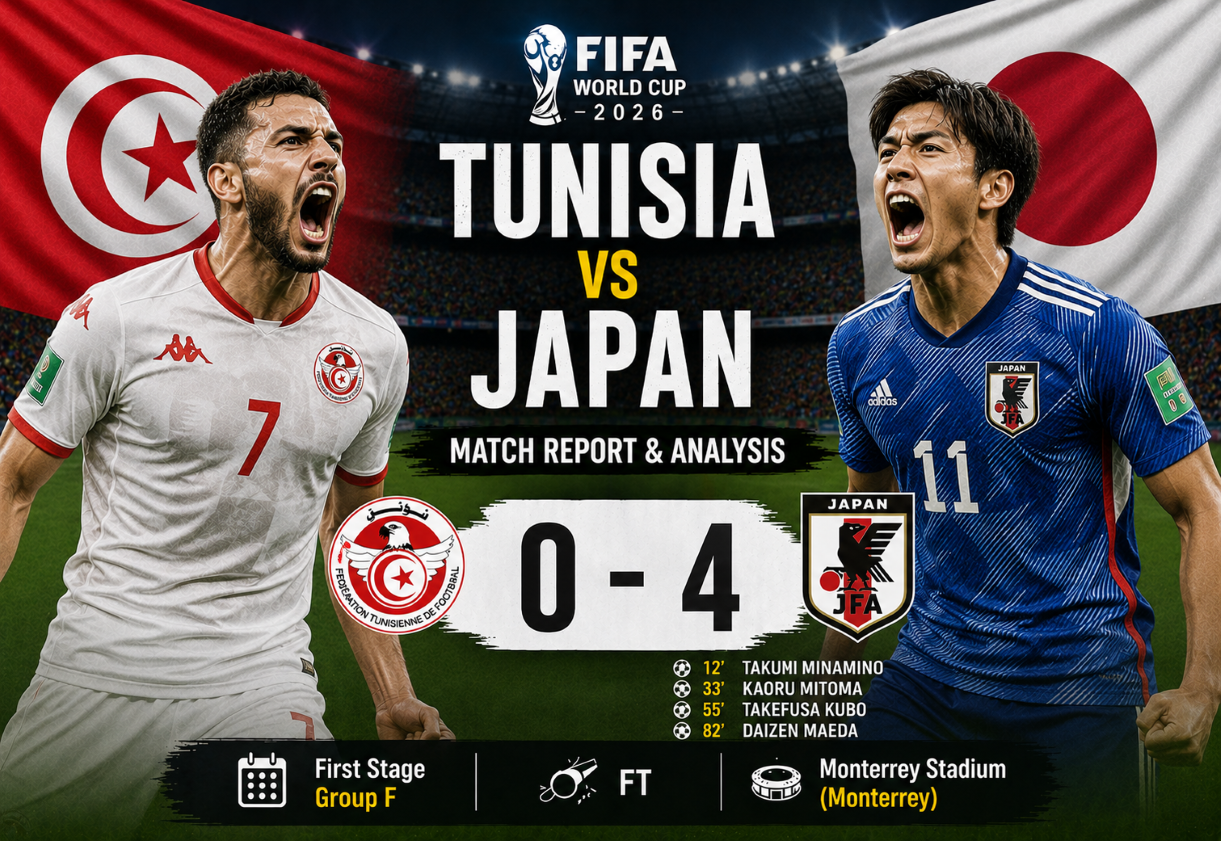
  • Tunisia 0–4 Japan | FIFA World Cup 2026 Group F Match Report at Monterrey Stadium

    Tunisia 0–4 Japan | FIFA World Cup 2026 Group F Match Report at Monterrey Stadium

    Tunisia 0–4 Japan: Clinical Samurai Blue Dominate Group F Clash in Monterrey

    Japan delivered a commanding performance to defeat Tunisia 4–0 in their FIFA World Cup 2026 Group F encounter at Monterrey Stadium. The match highlighted Japan’s tactical discipline, attacking efficiency, and ability to control the game from start to finish.

    Tunisia struggled to cope with Japan’s intensity and structured pressing, finding it difficult to build sustained attacking phases against a well-organized opposition.

    Match Overview

    From the opening whistle, Japan asserted control through high-tempo passing and coordinated pressing. Their midfield dictated the rhythm of the match, allowing them to dominate possession and consistently push Tunisia deep into their defensive third.

    Tunisia attempted to stay compact and disciplined, focusing on defensive shape and limiting space between the lines. However, Japan’s movement off the ball and quick ball circulation repeatedly disrupted their structure.

    First Half Analysis

    The first half saw Japan take full control of proceedings, maintaining possession and applying constant pressure in the attacking half. Tunisia were forced into a reactive approach, spending much of the half defending deep and clearing danger under pressure.

    Japan’s attacking combinations created repeated openings down the flanks and through central channels. Their ability to transition quickly from midfield to attack ensured Tunisia rarely had time to reset defensively.

    Second Half Dominance

    After the break, Japan maintained their intensity and continued to control the tempo of the match. Their attacking play became even more fluid, with quick interchanges and intelligent movement creating constant problems for Tunisia’s backline.

    Tunisia attempted to respond with more forward movement, but Japan’s defensive organization remained solid, preventing any meaningful breakthroughs. As space opened up later in the game, Japan capitalized with further goals to extend their lead.

    Tactical Breakdown

    Japan’s tactical approach was built on structured possession, high pressing, and rapid transitions. Their midfield controlled tempo effectively, while the forwards consistently created space through intelligent off-the-ball movement.

    Tunisia relied on a compact defensive block and counterattacking intentions, but struggled to progress the ball into dangerous areas. Japan’s pressing system limited their ability to build from the back or sustain possession.

    Key Match Statistics

    • Final Score: Tunisia 0–4 Japan
    • Competition: FIFA World Cup 2026
    • Stage: First Stage – Group F
    • Venue: Monterrey Stadium, Monterrey
    • Total Goals: 4
    • Winning Team: Japan
    • Goal Difference: +4

    Impact on Group F

    This dominant victory significantly boosts Japan’s position in Group F and strengthens their momentum heading into the next stage of fixtures. The result also enhances their goal difference, which could prove crucial in a tightly contested group.

    For Tunisia, the defeat highlights areas that need improvement, particularly in defensive organization under sustained pressure and transition play against high-tempo opponents.

    Conclusion

    Japan produced a complete performance to secure a 4–0 win over Tunisia in Monterrey. With control in midfield, sharp attacking execution, and defensive stability, the Samurai Blue delivered one of the standout Group F performances of the FIFA World Cup 2026.

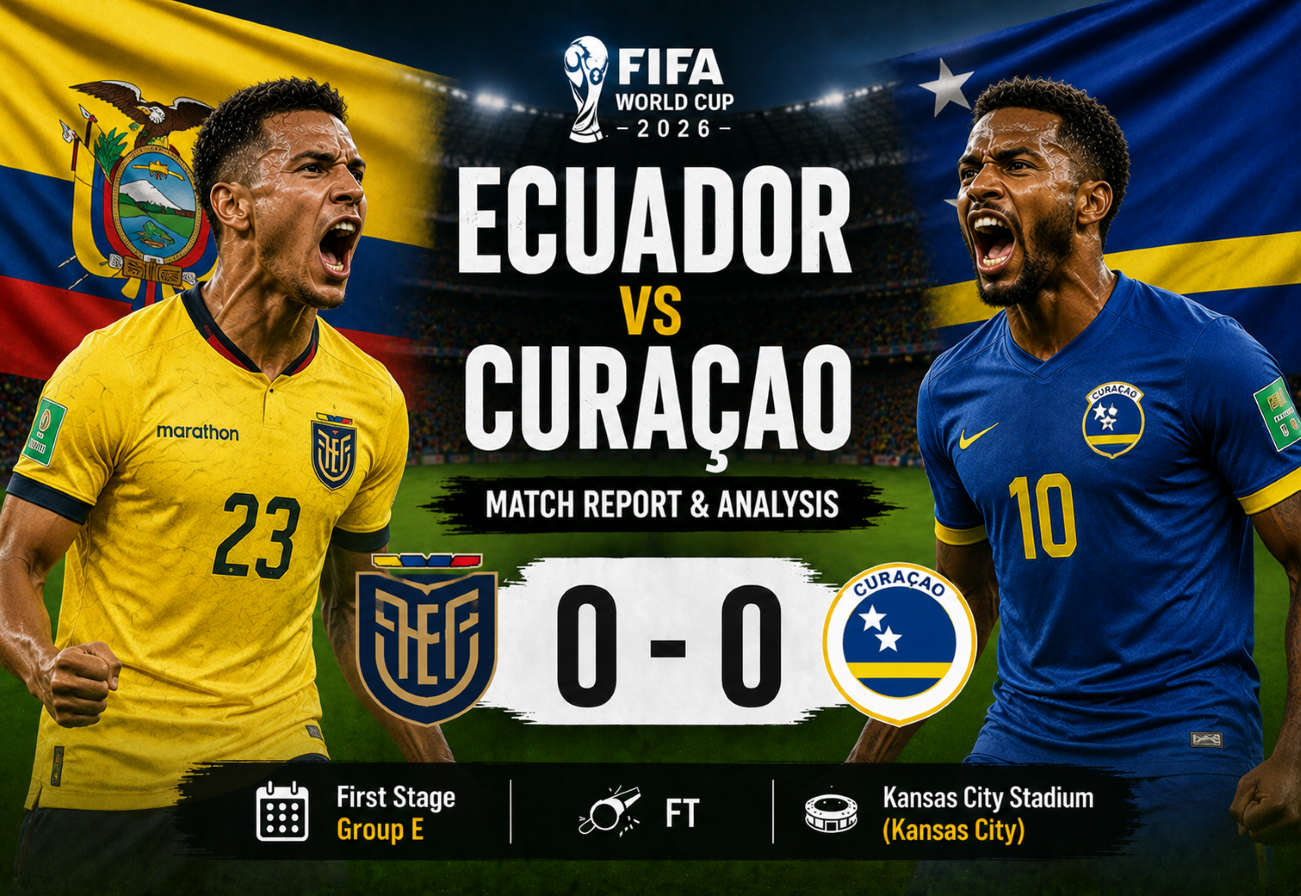
  • Ecuador 0–0 Curaçao | FIFA World Cup 2026 Group E Match Report at Kansas City Stadium

    Ecuador 0–0 Curaçao | FIFA World Cup 2026 Group E Match Report at Kansas City Stadium

    Ecuador 0–0 Curaçao: Stalemate in Kansas City as Defenses Dominate Group E Clash

    Ecuador and Curaçao played out a tense 0–0 draw in their FIFA World Cup 2026 Group E fixture at Kansas City Stadium. Despite both sides showing intent and structure, neither team could find the decisive breakthrough in a match dominated by defensive organization and midfield congestion.

    The result reflects a balanced contest where Ecuador controlled large spells of possession, while Curaçao’s compact defensive setup and disciplined shape ensured they remained difficult to break down throughout the 90 minutes.

    Match Overview

    From the start, Ecuador looked to impose themselves through possession-based football, circulating the ball patiently and attempting to stretch Curaçao’s defensive block. Their approach focused on building through midfield and exploiting wide areas, but Curaçao remained well-structured and denied space in dangerous zones.

    Curaçao approached the match with a clear defensive strategy, staying compact, maintaining tight lines, and prioritizing organization over high pressing. This forced Ecuador into slower build-up phases and reduced the number of clear attacking transitions.

    First Half Analysis

    The first half was characterized by Ecuador’s territorial dominance, with long spells of possession inside Curaçao’s half. However, despite controlling the tempo, Ecuador struggled to convert their possession into clear scoring opportunities due to Curaçao’s disciplined defensive structure.

    Curaçao remained patient and compact, absorbing pressure and attempting to break forward on rare counterattacks. While these transitions provided brief moments of relief, they did not result in sustained attacking pressure.

    As the half progressed, both teams cancelled each other out in midfield, leading to a low-risk, low-chance opening period that ended goalless.

    Second Half Development

    After the break, Ecuador increased their attacking urgency, pushing higher up the pitch and accelerating their passing tempo. This shift aimed to disrupt Curaçao’s defensive rhythm and create more direct chances in the final third.

    Curaçao responded by tightening their defensive shape further, maintaining concentration and continuing to block central passing lanes. Their defensive discipline ensured Ecuador were often forced into wide positions with limited penetration inside the box.

    Despite late pressure and increased attacking intensity from Ecuador, Curaçao held firm. The match gradually slowed in the closing stages as both sides appeared satisfied with avoiding defeat rather than risking overcommitment.

    Tactical Breakdown

    Ecuador relied heavily on structured possession, midfield control, and wide buildup patterns. However, a lack of cutting edge in the final third and difficulty breaking defensive lines limited their effectiveness.

    Curaçao’s tactical approach was built around defensive compactness, maintaining shape between the lines, and denying space in central areas. Their disciplined block forced Ecuador into predictable attacking patterns.

    The match ultimately became a tactical chess battle, with Ecuador unable to break down resistance and Curaçao unable to capitalize on counterattacking moments.

    Key Match Statistics

    • Final Score: Ecuador 0–0 Curaçao
    • Competition: FIFA World Cup 2026
    • Stage: First Stage – Group E
    • Venue: Kansas City Stadium, Kansas City
    • Total Goals: 0
    • Possession Battle: Ecuador dominant phases
    • Match Type: Defensive stalemate

    Impact on Group E

    This draw keeps Group E finely balanced, with both Ecuador and Curaçao adding a single point to their campaign. While Ecuador may feel they had enough control to secure a win, Curaçao will view this as a disciplined and valuable result against a possession-heavy opponent.

    As the group stage progresses, both teams will need to improve their attacking efficiency. Ecuador must find greater creativity and penetration in the final third, while Curaçao will aim to maintain defensive stability while becoming more dangerous in transition.

    Conclusion

    Ecuador and Curaçao shared a goalless draw in Kansas City after a match defined by structure, discipline, and tactical balance. While Ecuador controlled much of the game, Curaçao’s resilience ensured the points were shared in a tightly contested Group E encounter of the FIFA World Cup 2026.